
For a customer in Brazil or Peru, contacting a business may start with a WhatsApp link and a voice message. Asking about an appointment, checking a reservation, or following up on a purchase can happen in the same app used for everyday conversations. A team planning customer service around email and web forms can easily miss that starting point.
This becomes an operating challenge for a global organization. Customers want a familiar channel. Employees need a practical way to respond. The business needs to decide who can access the conversation, how sensitive content is handled, and what happens when a message needs attention. Giving everyone an ordinary messaging app does not answer those questions.
At SEI, I led the creation of a front-end for customer conversations using WhatsApp Business Platform APIs and a communications platform-as-a-service (CPaaS) layer. My goal, from product ownership to working with business, architecture, infrastructure, and development teams, was to make established customer habits work smoothly within a managed employee process.
Design for the conversation people already have
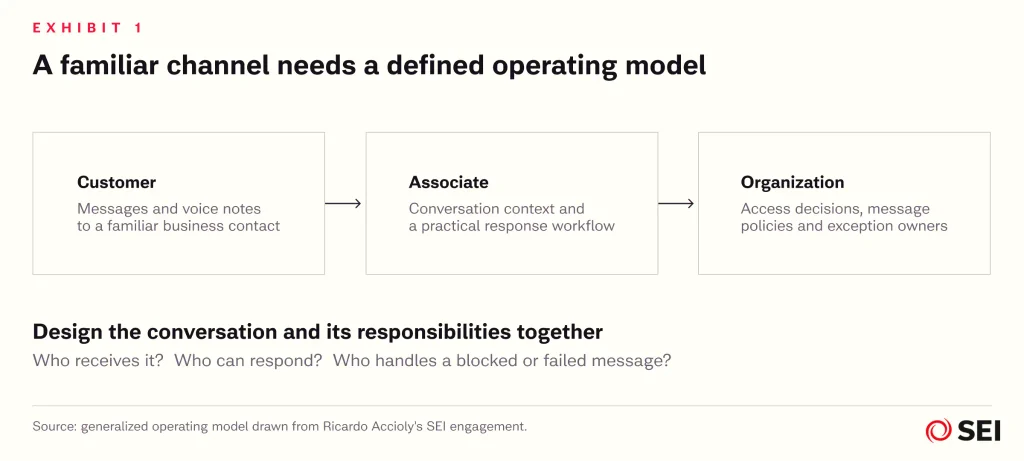
The first requirement was simple: associates had to receive and reply to customer messages sent to a business location. The real challenge was turning this interaction into a service the organization could manage and run.
This meant thinking about the employee experience as well as how messages are accessed and handled. Associates need enough information to reply helpfully, and supervisors need to see and understand the work happening. Another dedicated employee is needed to handle exceptions and provide support. These responsibilities should guide the product from the start, not be added as administrative tasks after the interface is built.
Put controls where the employee workflow can enforce them
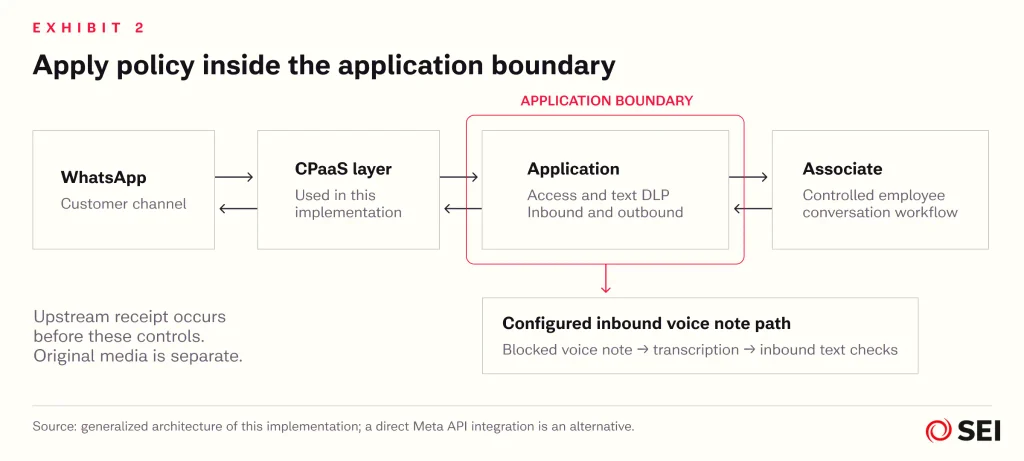
This implementation uses a CPaaS layer between WhatsApp and our application. Messages reach those upstream services before the application applies policy and presents conversations to authorized associates. Outbound text passes through the application’s policy workflow before submission to the messaging layer.
A CPaaS provider is an integration choice. A business can also connect its own application directly to Meta’s WhatsApp Cloud API. [2] In that model, the business operates the integration, employee interface, and governance controls; Meta hosts the messaging API.
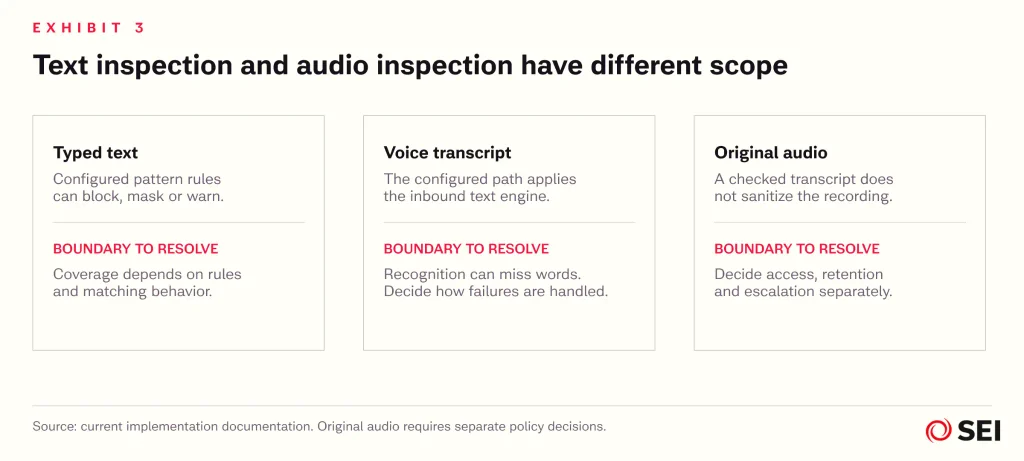
Data loss prevention, or DLP, rules help identify configured patterns in text. In this implementation, rule actions can block content, mask matching spans, or log a warning, depending on the policy. Those are distinct behaviors. A warning is not the same as removing information, and a record of a match is not proof that every sensitive value was found.
This boundary is important. Application controls cannot change a customer’s original message or remove information already received by upstream systems.
Give voice messages an explicit policy
Voice messages deserve attention because they are part of the customer experience. A text-only interface can overlook an important request. Allowing every audio attachment through without a defined policy can create a different problem.
The implementation supports a specific transcription path. When the relevant setting is enabled, an inbound voice note blocked by the media policy can be transcribed. The transcript then goes through the inbound text DLP engine. That makes configured text checks available for this path, while preserving the distinction between a transcript and the original recording.
Speech recognition can miss words or numbers. Checking the resulting text does not prove that the audio contains no sensitive information. A policy, therefore, needs to specify what happens to the original audio, what an employee can access, and how uncertain or failed transcription is handled. Those decisions are as important as choosing the transcription technology.
Global rollout needs local operating decisions
The product is now being used across multiple countries. Expansion makes local working practices more visible: language, voice-message preferences, associate availability, and the kinds of requests customers send. A consistent control framework still needs to accommodate those differences.
Channel rules also influence the service design. The WhatsApp Business Messaging Policy requires obtaining contact permissions and respecting opt-out requests. Free-form replies are generally limited to the customer service window; approved templates are required outside it. [1] Associates need a workflow that makes those constraints understandable when they reply, rather than discovering them through failed sends.
For future implementations, I would define ownership of message failures, blocked content, access changes, and policy updates before expanding the rollout. Teams also need to distinguish a provider’s acceptance of a message from its eventual delivery status. That distinction supports useful troubleshooting and avoids telling an employee that a customer has received something when the system only knows it was submitted.
Build the service around clear responsibilities
The value of this work was the connection between a familiar customer channel and an application designed for the people who operate it. Product decisions, integration, infrastructure, and governance had to develop together. The front end was one part of that service, alongside the policies and responsibilities surrounding it.
For a global organization considering a similar approach, I would start with a real customer conversation and follow it through the business. Who receives it? What information is needed to respond? Which content needs intervention? Who handles an exception? Answering those questions gives the architecture a concrete purpose and exposes decisions that a simple messaging integration can leave unresolved.
SEI helps organizations connect customer-facing technology with the controls and operating practices needed to support it. A focused assessment of one conversation workflow can identify the product requirements, integration boundaries, and policy choices needed for a workable first release.
Sources
[1] WhatsApp Business Messaging Policy: Read source
[2] Meta on direct access to the WhatsApp Cloud API: Read source