
Global messaging costs can hide inside a familiar workflow. A business sends a transactional update, the customer receives it, and the process repeats. At scale, differences in destination prices and channel availability turn that routine into a significant operating expense.
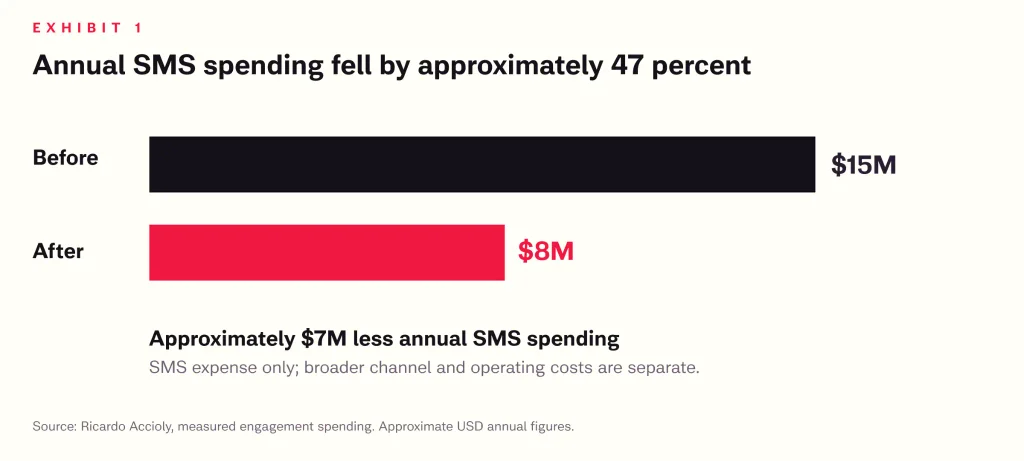
In an engagement I led at SEI, we evaluated messaging platforms and selected Bird as part of a change in how transactional messages were delivered to customers. Approximate annual SMS spending fell from $15 million to $8 million: about $7 million less, or a 47 percent reduction. Those figures reflect actual measured annual spending. They describe the SMS expense rather than the total cost of every messaging channel or the isolated impact of a single feature.
The important decision was to stop treating SMS as the automatic answer for every destination. We needed a platform that could use WhatsApp where it made economic and operational sense, then fall back to SMS under defined conditions. API access and integration with existing systems also mattered. A cheaper message would have little value if the business could not reliably trigger it, trace its progress, or handle exceptions.
Start with the cost pattern
Our evaluation began with the economics of the existing service. High message volume alone did not explain the expense. Destination pricing mattered, and a routing decision that worked well in one market could be expensive in another.
The analysis needs to connect message volume to purpose and destination. Which updates are time sensitive? Which customers can be reached on another channel? What permissions and templates does that channel require? These questions turn a rate comparison into a practical service design. They also help teams identify where a change could be useful before committing to a broad migration.
Make routing a business decision
Bird’s routing capabilities were an important part of the selection. The workflow could attempt WhatsApp where appropriate and use SMS when the WhatsApp attempt was unsuccessful. That gave us a way to change channel choices without rebuilding every sending application around its own routing logic.
This does not mean that WhatsApp is always cheaper, that every customer is reachable there, or that a fallback guarantees delivery. WhatsApp Business Platform pricing depends on the market and message category. Contact permissions, approved templates, channel availability, and the urgency of the update all influence the decision. [1, 2]
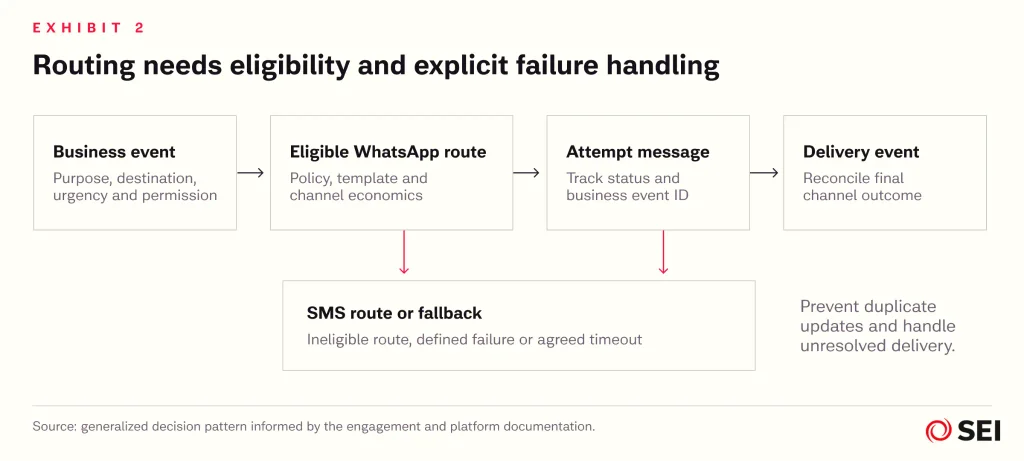
A robust implementation also needs precise definitions. An API accepting a request is different from a message being delivered. Delivery events arrive asynchronously, so the sending system needs to reconcile status updates against the original business event. [3] A failure and a timeout are different conditions; each needs an explicit response. If a delayed WhatsApp message arrives after an SMS fallback, the customer could receive two versions of the same update. The design should account for that possibility rather than treating fallback as a simple second send.
The routing diagram below illustrates the decision pattern. The timeout, retry, and reconciliation rules must agree with the specific service; they do not reproduce a client’s configuration.
Evaluate the platform around the whole workflow
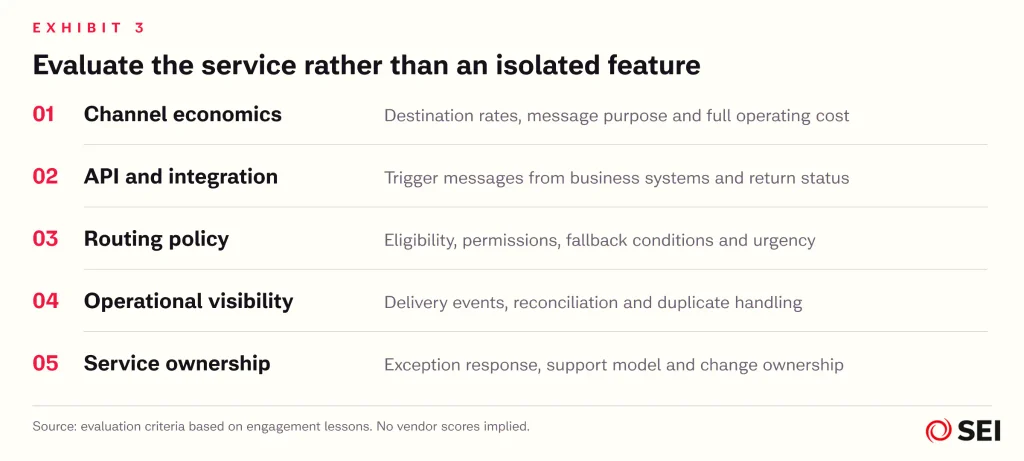
I evaluated multiple platforms before we selected Bird. Routing was a key feature, but it was part of a wider decision about integration and operations. An API-first platform made it easier to connect the messaging service to the other systems involved.
For a similar evaluation, I would ask teams to demonstrate how a business event becomes a message, how its final status returns, and how operations investigate a missing or duplicated update. A feature list is useful only when those capabilities work together.
Measure the result without losing the boundaries
The approximately $15 million-$8 million annual SMS comparison is a meaningful outcome. It is also a specific measure. A complete economic assessment would include WhatsApp charges, provider fees, licensing, implementation, and ongoing support. Moving an expense from SMS to another channel can reduce the SMS line without producing the same reduction in total operating cost.
For a new program, I would establish a baseline by destination and message purpose, then compare spending alongside service outcomes. Delivery status, time to reach the customer, fallback frequency, duplicate messages, and support demand can explain whether a lower cost is accompanied by a better operating model. Changes in volumes and destination mix also need to be visible when comparing periods.
That measurement discipline is useful during procurement as well. It gives the business a way to test a vendor’s routing claims against its own customer patterns. It also helps leaders decide which services to migrate first and what evidence they need before expanding the rollout.
Connect procurement to implementation
This engagement combined vendor evaluation with decisions about channel economics and integration. The result depended on treating those as connected parts of the same problem. The platform had to fit the business workflow, while the workflow had to use the platform’s capabilities deliberately.
For technology leaders, the opportunity is to examine the assumptions embedded in everyday communication. A channel chosen years ago may still be appropriate for some messages and markets. Other parts of the service may benefit from a different route, provided the team can explain the cost, permissions, customer experience, and exception handling.
SEI helps organizations evaluate technology choices and turn them into workable services. If global messaging costs are growing, a useful starting point is a review of destination-level spending and the journey of one important customer update. That provides a concrete basis for platform evaluation and a controlled first change.
Sources
[1] WhatsApp Business Platform pricing: Read source
[2] WhatsApp Business Messaging Policy: Read source
[3] Bird WhatsApp integration documentation: Read source