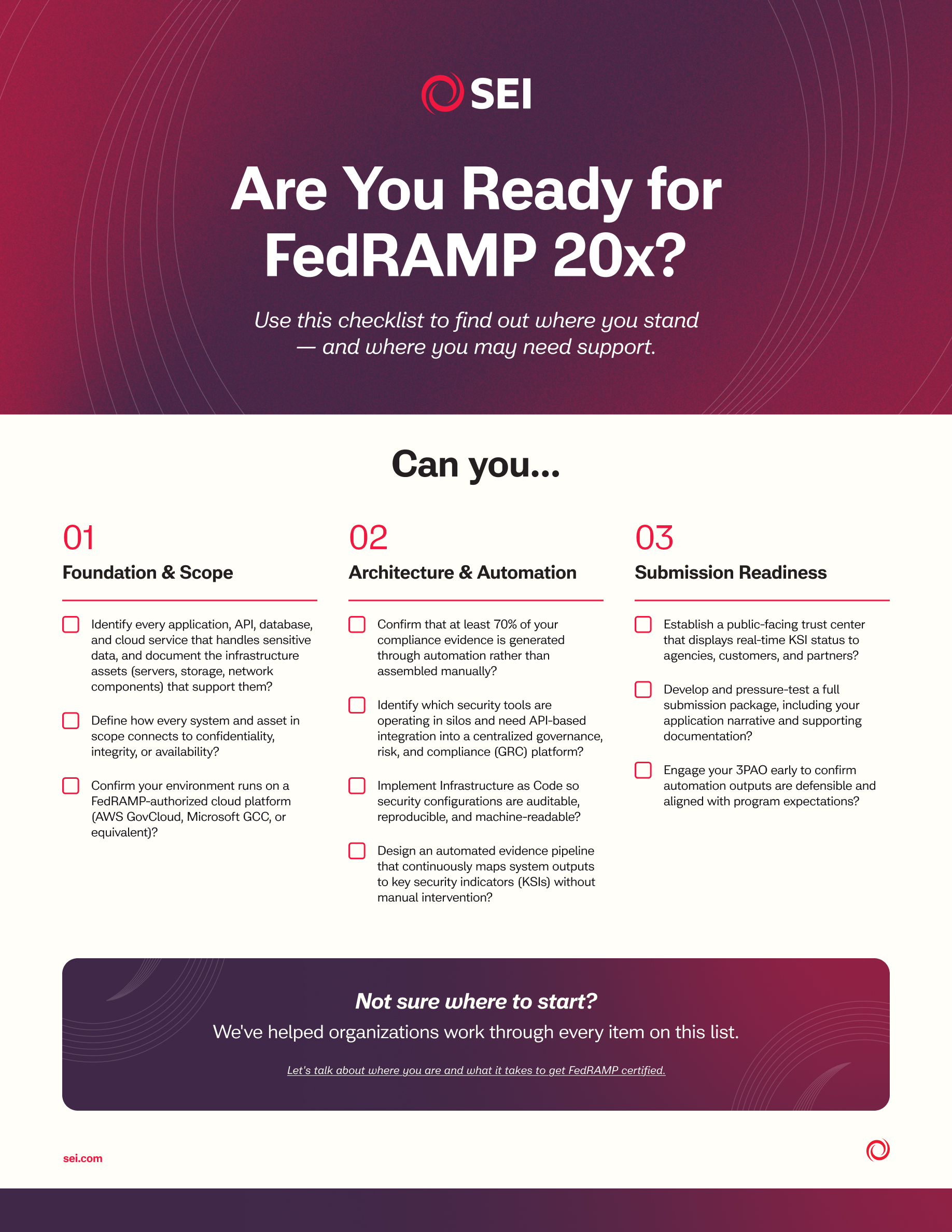
The federal cloud compliance model just changed. Organizations that embrace the FedRAMP 20x evolution will move faster, build more trust, and compete more effectively in the federal market.
Register for our upcoming event, FedRAMP 20x from Every Angle
For years, FedRAMP certification meant paperwork.
The process was grueling, expensive, and slow, often taking more than a year to complete. But a deeper flaw was its reliance on point-in-time assessments. Static audits revealed only a snapshot of an organization’s posture, not the current state. In a cloud environment where systems are constantly evolving and new threats emerge daily, that weak point matters.
FedRAMP 20x aims to close that gap, and it’s already changing how organizations earn and maintain federal trust. SEI supported one of only 13 organizations accepted into the FedRAMP 20x Phase 2 pilot, and we’ve since achieved Class C Certification. The higher the classification, the more sensitive the federal data a provider is cleared to handle — and the greater the contracting opportunities that come with it.
Everything we’ve learned along the way, we’re putting to work for our clients right now. Here’s an inside look at what it actually takes.
From Periodic Audits to Continuous Validation
FedRAMP 20x replaces document-heavy, periodic audits with continuous, automated security validation. Instead of assembling large evidence packages before an audit, organizations provide live, machine-readable signals. These Key Security Indicators (KSIs) show how systems are operating in real time.
KSIs track metrics such as vulnerability management velocity, logging coverage, encryption configuration, and access controls. When these signals are automatically collected from your systems, compliance shifts from a periodic task to a continuous process.
For some, the impact has been immediate. The U.S. General Services Administration (GSA) reported 114 FedRAMP certifications in FY2025 (more than double FY2024), with timelines dropping significantly for organizations with well-prepared programs. That progress shows what’s possible with the right capabilities in place. FedRAMP 20x may be more streamlined, but that doesn’t mean getting there is simple. The organizations doing the hard work of building the right capabilities now will be the ones moving through certification with the least friction when the program fully opens.
Compliance Happens Continuously, or It Doesn’t Really Happen
FedRAMP 20x preparation demands an engineering mindset. When security is woven directly into architecture and automated processes, compliance evidence becomes a natural output of everyday operations. Infrastructure as Code (IaC) is central to making that possible.
IaC makes security configurations auditable, reproducible, and machine-readable from day one. More importantly, it keeps configurations consistent. As your infrastructure evolves, IaC helps ensure new systems, services, and changes don’t silently drift away from the compliance posture you built. That’s why IaC works best as a living practice, not a one-time implementation.
That foundation connects to everything else:
- API-based integrations feed security tools into a centralized Governance, Risk, and Compliance (GRC) platform for a single, real-time source of compliance truth.
- Automated evidence pipelines continuously map system outputs to KSIs, keeping your security status up to date.
- A FedRAMP-authorized cloud environment, such as AWS GovCloud or Microsoft Government Community Cloud (GCC), provides the secure substrate for the entire architecture.
How and when you build these capabilities also matters. In our work through the 20x pilot, we consistently saw that teams who mapped their evidence pipelines before touching their systems moved through KSI reconciliation faster.
What Separates the Ready from the Rest
FedRAMP 20x is still taking shape, but the patterns are already clear. As the program expands to broader certification later this year, these characteristics will separate organizations that are ready from those still trying to catch up.
They build a trust center before they think they need one
A public trust center is where real-time KSI status becomes visible to the world. Agencies, customers, and partners can see that your security posture is transparent and verifiable. The organizations that build this infrastructure early find that it pays dividends well beyond the certification itself. Clean naming conventions, clearly mapped controls, and consistent evidence presentation matter just as much as the underlying technology.
They define scope before they touch their systems
Every asset or system in scope connects to the CIA Triad: confidentiality, integrity, and availability. A tighter scope means smoother progress, cleaner evidence, and a more sustainable program. It also creates alignment across engineering, security, and compliance teams from the start.
They treat FedRAMP as a collaborator
The 20x program is more collaborative and transparent than most organizations expect. FedRAMP focuses on the intent behind each requirement and actively invites novel approaches rather than prescribing rigid paths. Public GitHub forums, community working groups, and monthly public sessions give participants direct visibility into how the program is evolving. Organizations that engaged with these channels early during the Phase 2 pilot arrived at their reviews with clearer expectations and faced fewer friction points.
SEI’s Been There. We Can Get You There, Too.
Our work supporting an organization through the Phase 2 pilot gave us a clear picture of where organizations get stuck, what the program rewards, and how to navigate the process in a way that holds up under scrutiny.
Through this engagement, our client has achieved FedRAMP 20x Class C Certification, a significant milestone that gives us direct, end-to-end experience with the process as it exists today. Read the full client story here.
To us, every engagement is a partnership. No handoffs, no overhead — just our team, embedded with yours, through every phase:
- Readiness & eligibility assessment: Understanding where you stand before you engage
- Architecture & automation design: Engineering compliance into your systems from the start, including IaC strategy and evidence pipeline implementation
- Submission package development: Crafting a narrative that demonstrates both technical strength and alignment with the program’s goals
- Certification support: Direct support during FedRAMP engagement, feedback cycles, mock reviews, and 3PAO coordination
- Continuous monitoring optimization: Keeping your compliance infrastructure effective as your platform evolves
The timeline and investment will vary depending on your starting point. We’ve seen organizations with the right foundation move from readiness to certification in a matter of weeks, not the months that traditional FedRAMP processes have taken. We’ll give you an honest picture of both on our first call.
Ready to Build Your FedRAMP 20x Foundation?
FedRAMP 20x is more accessible than ever, but getting there still takes the right expertise, architecture, and preparation.